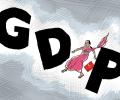
'Given that the economy is going through a slowdown, further downward revisions of the 2019-2020 growth estimates cannot be ruled out,' notes A K Bhattacharya.

While the electric version will open for bookings starting August 12, the internal combustion engine (ICE) counterparts will make their debut after September 2, says Rajesh Karkera/Rediff.com.

After contracting for two quarters in a row, the Indian economy entered the positive territory with a growth of 0.4 per cent in the October-December quarter, mainly due to good performance by farm, services and construction sectors, official data showed on Friday. Trade and hotel industry registered a contraction of 7.7 per cent during the third quarter this fiscal, as the sectors continued to suffer on account of coronavirus pandemic. According to the data released by the National Statistical Office (NSO), the farm sector recorded a growth of 3.9 per cent, and the manufacturing sector output grew by 1.6 per cent in the quarter under review.

Several experts are of the view that inflationary pressure, including that in food items, may build from October with economic activity gathering steam. However, the price movement in three key items of tomato, onions and potatoes, commonly known as TOP, may give some solace in the months to come. Traders and market watchers said the price movement in all the three will remain within the band sans any unusual spikes.

'We may see little softness in liquidity position after the stabilisation of the government.'

India's gross domestic product (GDP) growth during 2006-07 is estimated at 9.2 per cent as compared to 9 per cent during the previous year, advanced estimates of national income released by the Central Statistical Organisation say.

India's collection from tax on personal and corporate income jumped over 48 per cent in the current fiscal after a 41 per cent surge in advance tax payments, mirroring sustained economic recovery in a year that witnessed two waves of coronavirus infections. Net collections of direct taxes until March 16, 2022, in the fiscal year that started on April 1, 2021, stood at Rs 13.63 lakh crore compared to Rs 9.18 lakh crore in the same period a year back, an official statement said. The net collections in direct taxes, which is made up of income tax on individual income, corporation tax on profits of companies, property tax, inheritance tax and gift tax, in the current fiscal is 35 per cent higher than the collection of Rs 9.56 lakh crore in the pre-pandemic year of 2019-20 (April 2019 to March 2020).
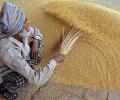
India has banned wheat exports with immediate effect as part of measures to control rising domestic prices, according to official notification. However, the export shipments for which irrevocable letters of credit (LoC) have been issued on or before the date of this notification will be allowed, the Directorate General of Foreign Trade (DGFT) said in a notification dated May 13. "The export policy of wheat ... is prohibited with immediate effect...," the DGFT said. It also clarified that wheat exports will be allowed on the basis of permission granted by the Government of India to other countries to meet their food security needs and based on the request of their governments.

From setting up cutting-edge facilities to cater to the domestic market and building capabilities of global standards, the action is building up.
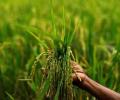
Riding high on the hopes of a normal monsoon, the agriculture ministry aims to increase foodgrain production by 6.35 million tonnes to a record 298.3 million tonnes in the 2020-21 crop year. The foodgrain output in the 2019-20 crop year (July-June) is estimated at an all-time high 291.95 million tonnes, as per the second advance estimates released by the ministry in February.

'The revenue projection arises out of all sectors doing well and the formalisation of the economy helps in making sure the tax domain gets widened.'

The government must develop a legally tenable mechanism in order to restore the cycle of simultaneous elections.

Nirmala Sitharaman on Wednesday assumed charge as the Finance and Corporate Affairs Minister for the second consecutive term and is slated to soon present the final Budget for FY '25 that is going to set the tone for the Modi 3.0 government's priorities and direction for Viksit Bharat. Upon her reaching the North Block office, Sitharaman was greeted by Finance Secretary T V Somanathan and other top officials. Minister of State for Finance Pankaj Chaudhary was also present. Chaudhary assumed charge on Tuesday evening.

India's growth slowed in three months through December from a revised 7.4% expansion in the previous quarter, but it was much stronger than expected.

Crops including fruit, vegetables account for 60% of GDP in agriculture, forestry, fishing sector.

For the country's maiden offshore mineral mining auction, the Centre is planning to relax the rules on the number of chances for bidding. Under the newly announced draft Offshore Areas Mineral (Auction) Rules and Offshore Areas (Existence of Mineral Resources) Rules, the ministry of mines is planning to offer three chances to potential bidders in its forthcoming inaugural offshore mining auction. If a single bid is not received during the second attempt, the plan is to initiate a new round of bidding for the third time.

The hit to economic activity will be mostly confined to the first quarter. And a third wave, if it materialises, is unlikely to be hugely disruptive for the economy, predicts T T Ram Mohan.

Higher growth in vegetable demand relative to supply in the recent past has led to an upward trend in inflation, with spikes becoming more frequent. A study by rating agency Crisil found that vegetable inflation has been the most volatile in the food category, in fact. Inflation volatility is detrimental for both consumers and farmers and also sidetracks policymakers in the short term, necessitating frequent and repeated price-smoothing measures.

The robust revenue collection reinforces hope of a good economic performance in the third quarter of financial year 2020-21 after the surprising pickup seen in Q2.
The downward surprise in Q2 stemmed from a stronger-than-anticipated drag from gross fixed capital formation and marginal weakness in private final consumption expenditure. In Q3, projection errors emanated mainly from a steep unanticipated contraction in gross fixed capital formation, which was the deepest in the new series of GDP.

After seeing a good rise in box office collections over the first weekend, Rocky Aur Rani Kii Prem Kahaani had stable weekdays ahead.
The Monetary Policy Committee (MPC) is expected to maintain the status quo on policy rates for the fourth consecutive time in its October 4-6 review meeting. The incremental information available since its last meeting in August suggests that growth and inflation prints for the second quarter (Q2) of financial year 2023-24 (FY24) will exceed the committee's projections. However, the Consumer Price Index (CPI)-based inflation is expected to moderate in the second half (H2) of FY24.

With the fight now having been taken to the seizure of nuclear plants, it is one more warning to Europe that this prolonged war could end up with disastrous consequences, observes Rashme Sehgal

The NCEAR has indicated some improvement in the fourth quarter of the current financial year.

Chief Economic Adviser K V Subramanian on Monday said the overall impact of the second wave of COVID-19 on the country's economy is not likely to be large but cautioned about an uncertainty surrounding the pandemic going ahead. He further said that given the circumstances due to the pandemic, it is difficult to forecast if the country would achieve a double digit growth in the current fiscal. The Economic Survey 2020-21 released in January this year had projected GDP growth of 11 per cent during the current financial year ending March 2022.

The latest official numbers on the price of agricultural produce gives an idea of what's fueling the farmers' protest in Delhi.

In fact, India's investment activity growth is also estimated to touch a 17-year low in FY20. With overall demand not showing signs of revival, investment activity may take longer to recover, economists said.

India's economic growth slowed to 3.1 per cent in January-March and to an 11-year low of 4.2 per cent for the full fiscal 2019-20 amid a drop in consumption and investment. The Gross Domestic Product (GDP) growth stood at 5.7 per cent in the corresponding quarter of 2018-19, according to data released by National Statistical Office (NSO) on Friday.

In the coming few weeks, agriculture markets in North and Central India will be full of wheat, mustard, and chana - the three main rabi crops grown in these parts. Not only will the price trajectory of these determine the course of food inflation in the months to come, but it could also have a wider impact on the rural economy in the main growing states for these crops. Wheat and chana are largely grown in Madhya Pradesh (MP).

As a percentage contributor to nominal GDP, PFCE's share was 60.1 per cent in FY23, compared with 59.6 per cent and 60.8 per cent in the two preceding fiscal years. "Although PFCE is expected to grow 7.7 per cent in FY23, we believe it is still short of a broad-based recovery. "The current consumption demand is highly skewed in favour of goods and services consumed largely by the households falling in the upper income bracket. "A broad-based consumption recovery, therefore, is still some distance away," said Sunil Kumar Sinha, principal economist with India Ratings.

India's GDP is estimated to contract by a record 7.7 per cent during 2020-21 as the COVID-19 pandemic severely hit the key manufacturing and services segments, as per government projections released on Thursday. Amid overall decline in economic activities, some respite was provided by the agriculture sector and utility services like power and gas supply, which have been projected to post positive growth during the current fiscal ending March 2021.

'We now look at divestment as an opportunity for maximising the value of public assets, not necessarily as a short-term resource-raising measure.'

Oilseed output to surpass its previous record of 32.75 mt in 2013-14 to 33.59 mt this year
HDFC Bank's January-March quarter result, which came in-line with expectations, failed to enthuse investors. The reason? The management's decision to abstain from providing any specific growth guidance, and analysts' expectations of an arduous road to recovery. Analysts believe the path to normalisation of several growth metrics is unlikely to be a straightforward one, and the road to balance sheet realignment may be long.

Rating agencies Crisil and Icra on Monday revised down their India growth projections for the current fiscal and the second quarter mainly due to the ripple effect of slowdown in global growth and mixed crop output. Crisil downgraded the India growth forecast by 30 bps to 7 per cent while Icra pegged the economic expansion at 6.5 per cent for the second quarter of FY2022-23. "We have revised down our forecast for real gross domestic product growth to 7 per cent for fiscal 2023 from 7.3 per cent, primarily because of the slowdown in global growth that has started to impact our exports and industrial activity.
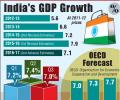
'I expect fourth quarter GDP growth to be sharply down.' 'I would imagine it would shave off at least one percentage point, if not more, as compared to the third quarter.'
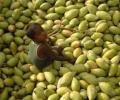
Intermittent storm in the first week of March hit the flowers and emerging buds.

But the government will present a second tranche of Supplementary Demands for Grants during the Budget session of Parliament in February, when it can seek additional spending.

The US decline decelerates on the back of public spending.

'The UK is more of a structural problem, and that's why we're doing the restructuring.'
 © 2026 Rediff.com - Advertise with us - Disclaimer - Privacy Policy - Sitemap - Feedback - About us - Terms of use - Grievances